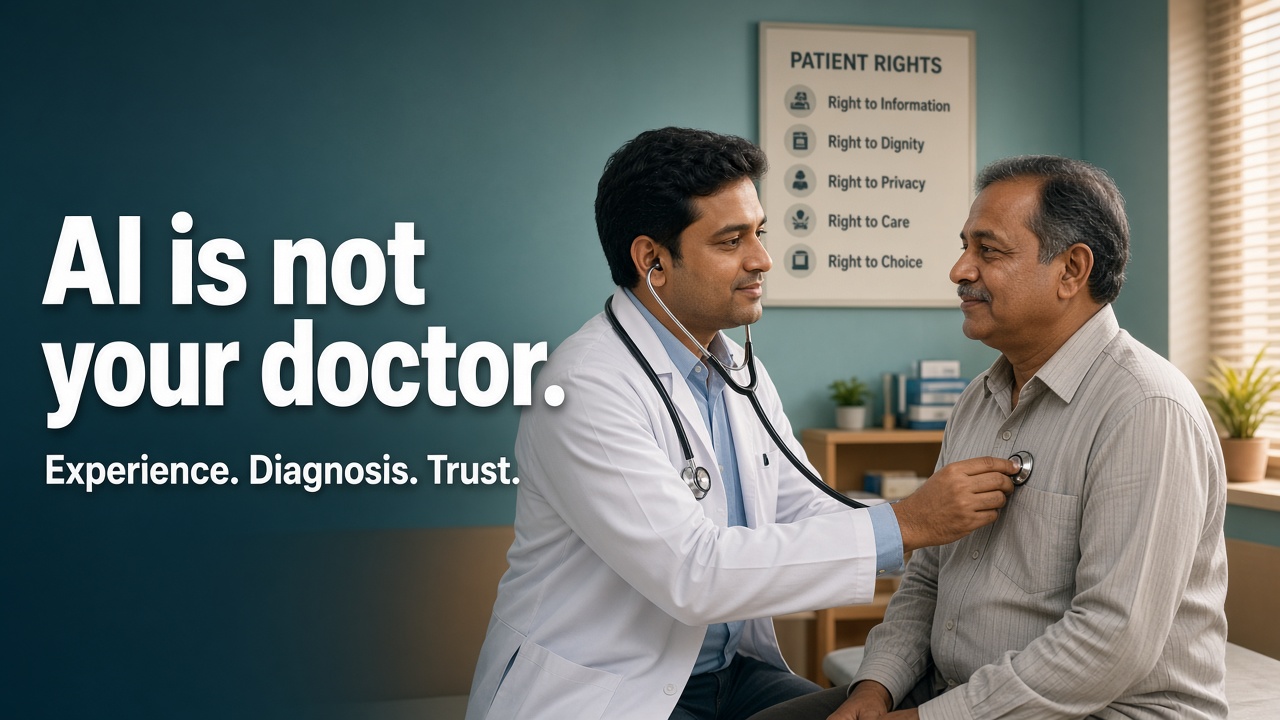
AI is not your doctor.
It can answer in seconds. It cannot examine you, carry the years of clinical judgment, or take responsibility when the advice is wrong.
Kunwer Sachdev
Founder, doctorrating.in · 5 min read
Late at night, a fever won’t break. Or a chest feels tight. Or a child’s rash looks worse under the kitchen light. Someone opens ChatGPT, Gemini, or another AI and types a question that used to go to a doctor:What medicine should I take?
The reply arrives in seconds — confident, tidy, and dangerously easy to act on. That is the trap. AI is progressing at a startling pace. But speed is not the same as care. A model can summarise what it has read. A doctor still has to see the patient, weigh the history, examine the body, and own the call.
Experience. Diagnosis. Treatment. Trust. Those still belong to a human who can stand in front of you — not a chat window.
AI can talk. It cannot take responsibility.
When a registered doctor treats you, there is a licence, a clinic, a name on a prescription, and — when things go wrong — a path to complain. When an AI suggests a tablet, there is none of that. No stethoscope. No blood pressure cuff. No duty of care written in law the way a practitioner’s duty is. If the advice is wrong, the chatbot does not sit with your family in the emergency ward.
Patients sometimes treat fluent English as proof of medical competence. It is not. Fluency is a language skill. Diagnosis is a clinical one. Confusing the two is how people end up self-medicating from a screen.
Use AI as a map. Never as a doctor. Maps don’t prescribe antibiotics.
Four India stories that should stop you mid-scroll
1. Fever, monsoon season, and “just take an antibiotic”
In many Indian cities, a few days of fever in the rains is not “viral, take rest and azithromycin.” It can be dengue, malaria, typhoid, or something that needs a blood test before a single tablet. An AI that has never felt your pulse or looked at your platelet count may still sound sure. Families who start antibiotics on chat advice risk masking the real illness, breeding resistance, and delaying the lab work that would have named the problem. A local doctor who has seen this monsoon’s pattern in the neighbourhood is not “old school.” They are reading the room you actually live in.
2. Chest pain dismissed as “acidity”
Gas and heart trouble can feel similar. A chatbot may list both and lean toward the less frightening option — antacids, avoid spicy food, sleep it off. In India, where people often wait too long to seek help for cardiac symptoms, that soft landing can cost hours. A doctor listens for radiation to the arm or jaw, checks blood pressure, asks about diabetes and smoking, and decides whether you need an ECG now. Trust, in that moment, is not a vibe. It is a decision under uncertainty — and the person deciding has trained for years to hold that uncertainty without gambling with your life.
3. A rash, a cream from the chemist, and steroid misuse
Skin looks simple until it is not. Someone pastes a photo into an AI, gets “fungal infection — try a steroid cream,” and buys whatever the medical store offers without a prescription conversation. Steroid creams used on the wrong rash can thin the skin, worsen infection, or create a rebound that needs months of specialist care. A dermatologist or even a careful GP looks at distribution, itch, borders, and history — and knows when “home remedy” is a polite word for harm.
4. A child’s dose from a chat window
Parents under stress ask AI for syrup doses by weight. Children are not small adults. Kidney function, age bands, formulation strength, and when not to give a drug matter as much as the milligram number. One wrong decimal, one adult tablet crushed “because the AI said it was fine,” and a paediatric emergency begins. No model has examined that child. No model will explain the overdose to a court or a grieving family. A paediatrician will still ask you to come in — and that friction is a feature, not a bug.
Why trust still wins
Technology will keep getting smarter. That is not the debate. The debate is what patients do with that intelligence. AI can help you prepare better questions for a visit, decode a lab abbreviation, or find how toverify whether a doctor is NMC-registered. Those are good uses. Crossing the line into “start this medicine tonight” is not empowerment. It is outsourcing your body to a system that does not know you, cannot examine you, and will not pay the price if it is wrong.
A good doctor’s edge is not only knowledge stored in books. It is pattern recognition built from thousands of real cases, the humility to order a test, the courage to say “I don’t know yet,” and the relationship that makes a patient tell the truth about alcohol, missed pills, or fear. Trust is often the biggest winner in medicine because healing starts when someone feels safe enough to be honest — and believed.
What to do instead
- Ask AI for questions, not prescriptions. Use it to list what to ask the doctor — never to decide the tablet.
- See a registered practitioner for symptoms that worry you, especially fever in monsoon, chest pain, breathlessness, severe headache, or anything in a child.
- Verify the doctor on official NMC / State registers before you rely on them.
- Keep the chemist honest. Do not pressure for prescription drugs without a proper Rx. Do not treat chat screenshots as one.
doctorrating.in exists so patients can check credentials, understand their rights, and get heard — not so a machine can replace the person in the white coat. AI will keep answering. Doctors will keep diagnosing. Know which one is which before you open the medicine strip.
Want the other half of the story — how hospitals use clinical-grade AI with licensed doctors? ReadThe Physician–AI Synergy.
Share this
Kunwer Sachdev
Founder, doctorrating.in
He built Su-Kam into one of India’s best-known inverter and solar brands, holds 100+ patents, and is building again — now backing ideas that put more power in ordinary people’s hands.
Related reading
- Second medical opinion in India — when and how →
- Hospital refuses medical records — what to do →
- How to check a hospital bill for overcharging →
- How to file a medical complaint in India →
- How to verify a doctor in India →
- The Physician–AI Synergy →
- Insured, but not protected →
- Well enough to leave. Not allowed to go. →
- Should justice cost ₹500? →
Need to act now?
Opinion piece for general information; not medical advice. Do not start, stop, or change medicines based on AI chat or this article — consult a registered doctor. Disclaimer:Kunwer Sachdev has no association with Su-Kam Power Systems Ltd. in its current form, having ceased to be its Managing Director and Promoter following insolvency proceedings under the IBC, 2016 (NCLT resolution, 2019–2022).
Need a real doctor — not a chatbot?
Verify NMC registration for free, or route a complaint to the authority that can actually act.
Free tools · No paid rankings · You act in your own name